Growing old without looking old — what really counts in the senior
Many complaints that pass for age-related are not. A look at what can be influenced.
Equiterna Redaktion
Senior health · after NRC, GfE and ECEIM
Horses live longer than they used to. Thirty is no longer a rarity, and many of them are rideable to the end. That raises a question which in this form did not exist for a long time: what of the things we take for signs of ageing is actually unavoidable — and what is the consequence of conditions one can change?
The answer turns out pleasingly pragmatic. A considerable part of what stands out in the old horse goes back to three things: teeth, movement and a ration that no longer suits the digestive tract. All three are within reach.
The tooth decides the ration
Horses' teeth keep growing throughout life, but not without limit. In high age the reserve is used up, teeth loosen or are lost, the occlusal surface becomes irregular. The horse can then no longer break down forage sufficiently — and precisely here begins the chain that ends as age-related emaciation.
The most visible sign are quids: incompletely chewed balls of feed, spat out again. Whoever finds them holds an observation that belongs in the dental check. Less conspicuous is the creeping weight loss with an apparently normal appetite.
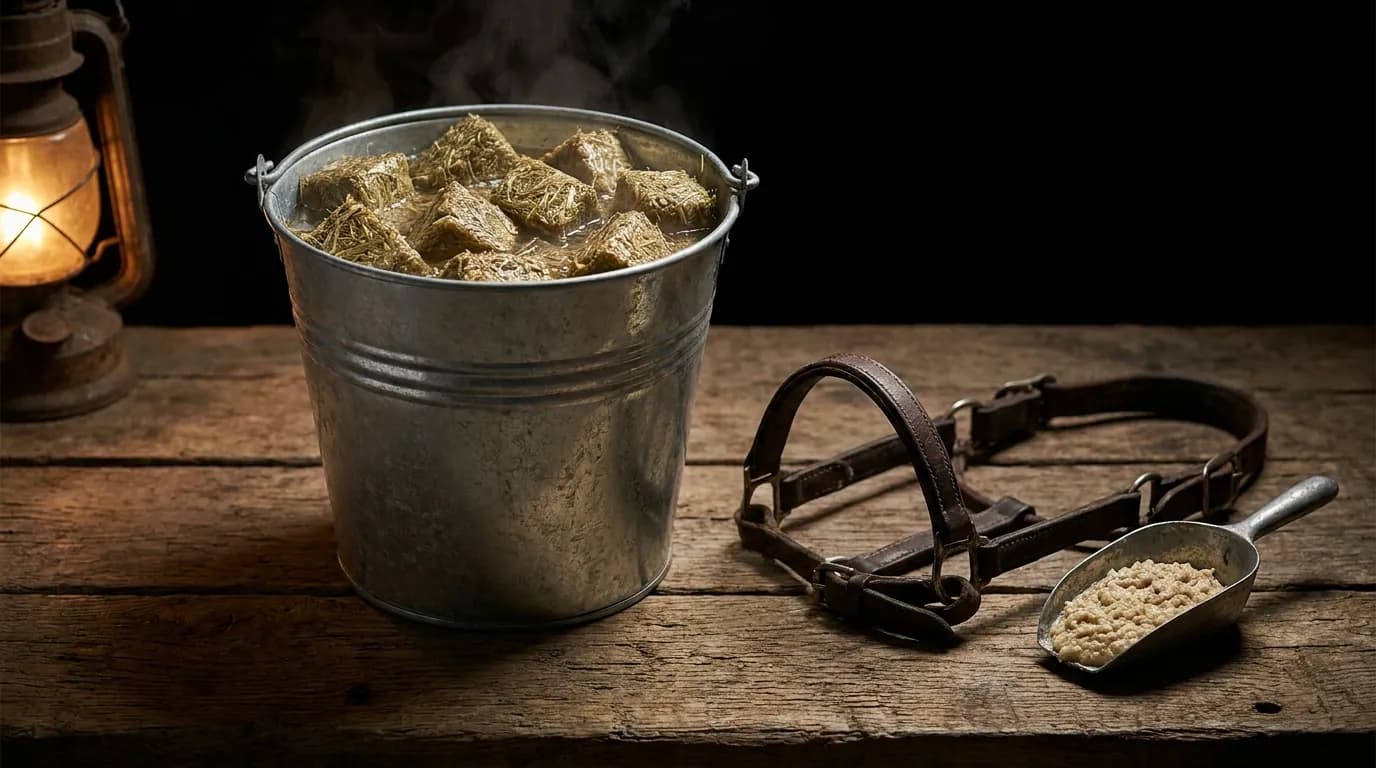
Practice: from about 15 years the dental check belongs in a fixed annual rhythm, in high age rather every six months. No complementary feed compensates for what a horse cannot chew — the ration must then be changed over to soaked, short-fibre alternatives.
Protein becomes more important, not less
A widespread error is that old horses need less. In fact the ability to absorb nutrients and to build muscle protein declines with age — the requirement for high-quality protein therefore tends to rise. What matters is the amino acid composition, above all lysine as the first-limiting amino acid in the horse.
The typical age-related loss over the spine and at the croup is therefore rarely a question of age alone. It is mostly a question of protein quality and movement stimulus — and both can be influenced.
Movement is the strongest lever
There is no measure that achieves as much in old age as daily free movement. It maintains musculature and joint function, supports the perfusion of the tissue and acts on gut motility. An old horse's body that stands breaks down faster than one that moves — even when the movement has become slower.
The perfusion is the underestimated part of it. The exchange of substances between blood and tissue takes place in the capillaries, the finest vessels, with a wall a single cell layer thick. What does not arrive there is missing from the cell — regardless of how good the ration is. Movement is the most reliable and the cheapest way to keep this supply going.
What belongs to veterinary clarification
A part of the complaints of age is not ageing but a disease with a name. The most important is PPID, formerly called Cushing: a delayed or absent coat change, long curly hair, muscle loss despite good feeding and recurring laminitis are the classic indications.
Important: PPID can be captured well via an ACTH determination and is treatable. Whoever dismisses the delayed coat change in the old horse as normal gives away the time in which the treatment achieves the most.
Likewise to be clarified are recurring colics (in the senior more often through lipomas), a drop in performance with coughing (equine asthma) and any swelling, especially in greys.
Antioxidant supply
With age the balance between oxidative load and antioxidant capacity shifts. Vitamin E is the most important fat-soluble protective substance for cell membranes and is barely stored — in a senior without pasture access the supply is regularly tight.
Here too the sequence applies: pasture access, where possible, beats any supplementation. Only where it is not possible does targeted supplementation become a topic — and then in veterinary agreement, because vitamin E and selenium have to be considered together.
The measure is quality of life
In the old horse, what counts as a good outcome shifts. Not every finding has to be treated, and not every diagnostic step is in the animal's interest. The most usable measure is an everyday one: does it eat willingly, does it move willingly, does it seek contact with the herd, does it lie down and get up again without effort?
These four questions say more about the condition of a senior than most individual values. Whoever asks them regularly notices changes early — and has the time it takes to decide well.
Sources
Compounds in this article
Usage note
This content is for information and education. It does not replace veterinary diagnosis or treatment. If your horse shows signs of illness, consult a veterinarian.
Keep reading
Summer eczema — why the skin is rarely where it starts
The reaction to the midge bite is the visible part. What lies beneath it decides the course.
HealthWhen the coat whispers — what the coat change reveals about the metabolism
Twice a year the horse rebuilds its entire coat. What happens in the metabolism while it does — and which signs can be read.
NutritionVitamin E in winter — why the hay ration is not enough
Preserved forage loses alpha-tocopherol. A look at supply gaps and the body of evidence.