When the coat whispers — what the coat change reveals about the metabolism
Twice a year the horse rebuilds its entire coat. What happens in the metabolism while it does — and which signs can be read.
Equiterna Redaktion
Metabolism · after NRC, GfE and ECEIM
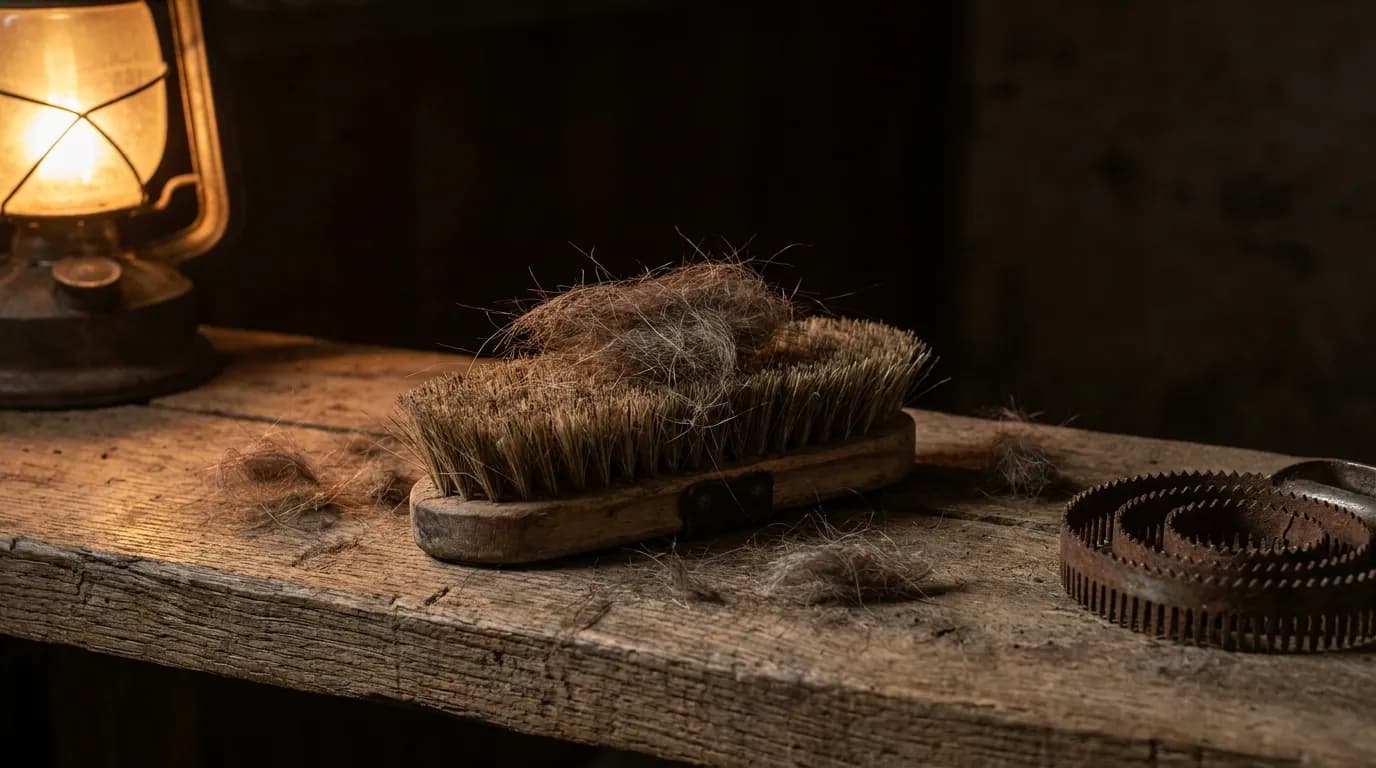
The coat change looks like a side stage: the horse sheds, one brushes more, after a few weeks it is over. In fact it is one of the metabolically most demanding phases of the horse's year. To build a complete coat anew means cell division on a large scale, and that costs energy, protein and trace elements.
Precisely for that reason the coat is such a reliable indicator. It shows not what was there yesterday, but what was available over weeks. Whoever learns to read it recognises bottlenecks before they make themselves felt elsewhere.
The pacemaker is the light, not the temperature
It is a widespread error that the first warm day triggers the coat change. The actual stimulus is the length of daylight. Via the retina and the pineal gland it steers the release of melatonin: long nights mean much melatonin, shortening nights less. This signal acts on the release of prolactin, and prolactin is regarded as the central switch for the coat change.
In practice this means: the rebuilding begins long before the weather suggests it. The winter coat change is already set in motion around the winter solstice, when the days grow longer again — in frost and snow. Whoever finds the first hairs in the brush in February sees no premature spring, but a reaction to light.
Practice: continuous light in the stable shifts this signal. Where the lights burn long into the evening, the horse is told a different day length than the one outside. With a sluggish or badly timed coat change, a look at the lighting times is worthwhile.
What the coat achieves
The coat is not a garment but an adjustable system. Guard hair and undercoat work together: by raising the hairs the horse changes the thickness of the insulating layer of air and with it its own heat loss — a fine regulation that no rug reproduces.
The skin beneath it is more than a covering. It is a barrier against germs, a temperature regulator via the sweat glands and an active metabolic organ. A glossy, closed coat is therefore not a cosmetic detail but an indication that barrier and cell metabolism are working.
Why the rebuilding is expensive
Hair consists predominantly of keratin, a sulphur-rich structural protein. To build it the organism needs sulphur-containing amino acids — above all methionine and cysteine — as well as zinc and copper as cofactors of the enzymes involved. If one of them is missing, the coat change is not called off; it runs more slowly and in poorer quality.
What makes it harder is that zinc and copper hinder each other in absorption and both compete with iron. A deficiency therefore arises not only from too little in the trough, but also from an unfavourable ratio. A ration calculation says more about this than any single supplement.
The second factor is the supply of the tissue. Hair follicles sit at the end of fine vessels; what arrives there depends on the perfusion of the terminal vascular bed. That explains why coat problems often appear first at the places that are perfused worst — at the distal limbs and over the withers.
Skin and gut are connected — read with a sense of proportion
In human medicine the connection between the gut microbiome and skin health is well investigated. In the horse this research stands considerably closer to the beginning, and that belongs said alongside: the connections are plausible and are increasingly described, but they are not evidenced to the degree they are in humans.
What can be said: the horse's large intestine is the place where a large part of the energy and vitamin supply arises. If the microbial colonisation gets out of balance — through starch-rich feeding, abrupt feed changes, worming or stress — that affects the nutrient supply of the whole organism. That this also shows in the coat is no bold assumption.
“A dull coat is rarely a coat problem. It is usually the most visible end of a longer chain.”
The practical conclusion is unspectacular and effective: whoever wants to improve coat quality begins with forage quality, the feeding intervals and the amount of starch — not with a complementary feed for the coat.
When the coat change becomes sluggish
A delayed, incomplete or unusually strenuous coat change is a signal, not a fate. Frequent backgrounds are a tight trace element supply, a high overall load from training or housing — and in the older horse very often PPID.
Important: if in a horse over 15 years the coat change fails to appear, if long hairs remain at the lower neck and on the legs, or if the coat becomes curly, that belongs in veterinary clarification (ACTH determination). This is the classic route by which PPID is recognised — and the earlier, the better it can be accompanied.
Also worth noting is the connection with the immune system. The rebuilding binds resources; in this phase infections and skin irritations accumulate. That is not a weakness of the individual horse, but an expectable consequence of a high baseline load.
What really helps in this phase
The sequence is decisive. In first place stands the ration: sufficient forage of good quality, a requirement-covering mineral supply with a coherent zinc-copper ratio and enough protein in a good amino acid composition. Only after that do supplementary active substances come into consideration — and then as a supplement, not as a replacement.
In second place stands movement. It is the most effective lever for the perfusion of the tissue, and it costs nothing. Daily free movement achieves more in this phase than most additives.
In third place stands grooming — and for a concrete reason: thorough currying removes loose hair, stimulates the circulation of the skin and is at the same time the best opportunity to notice changes early. Whoever has their horse in hand daily during the coat change finds skin patches, scratches and swellings before they become a problem.
And finally: the coat change is a good moment to review the load. Herd changes, transports, irregular feeding times and training peaks hit the organism harder in this phase than otherwise. Where something can be shifted, it is worth it.
The view that remains
The coat change is not a disturbance to be switched off, but an achievement to be accompanied. Twice a year it makes visible how well feeding, housing and load fit together — more openly than any other phase.
Whoever looks closely in this time gets information about the condition of their horse that no single laboratory value delivers. That is the real value of the subject: not another product, but a trained eye.
Sources
Compounds in this article
Usage note
This content is for information and education. It does not replace veterinary diagnosis or treatment. If your horse shows signs of illness, consult a veterinarian.
Keep reading
Summer eczema — why the skin is rarely where it starts
The reaction to the midge bite is the visible part. What lies beneath it decides the course.
HealthGrowing old without looking old — what really counts in the senior
Many complaints that pass for age-related are not. A look at what can be influenced.
NutritionVitamin E in winter — why the hay ration is not enough
Preserved forage loses alpha-tocopherol. A look at supply gaps and the body of evidence.