Recognising PPID — what stands behind Equine Cushing's Syndrome
Delayed, curly coat shedding, muscle loss and a laminitis tendency in the older horse: why a hormonal disease of the pituitary gland can lie behind these signs and how the diagnostic path looks.
Equiterna Redaktion
Veterinarian · Sports medicine
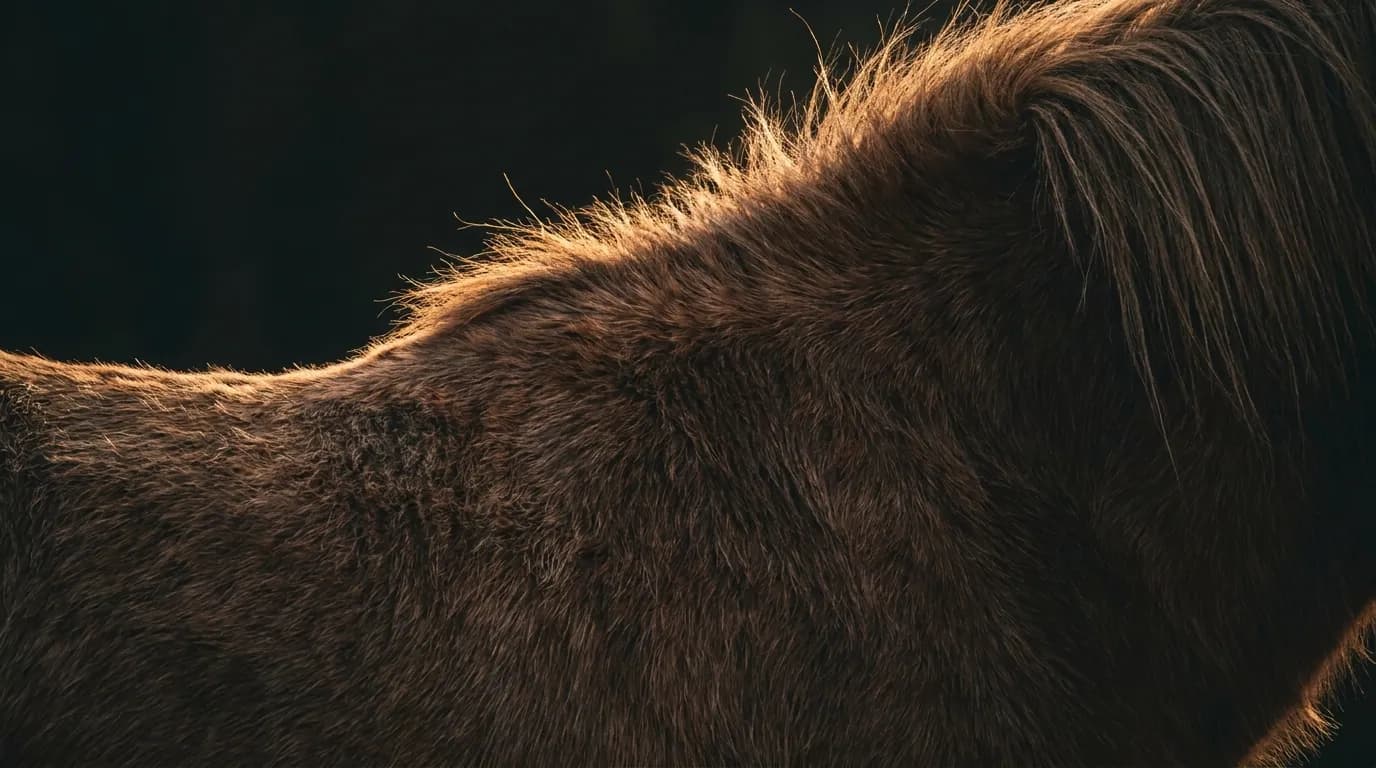
Pituitary Pars Intermedia Dysfunction (PPID), colloquially Equine Cushing's Syndrome, is the most common hormonal disease of the older horse. The older name is somewhat misleading: unlike in the classic Cushing's of humans, the cause does not lie primarily in the adrenal gland, but in a loss of control at the level of the brain.
What happens in the pituitary gland
PPID is a slowly progressing, degenerative change of dopaminergic nerve cells in the hypothalamus. These neurons normally inhibit the pars intermedia, a part of the pituitary gland. If they are lost through oxidative damage, this dopaminergic brake falls away — the pars intermedia proliferates and produces hormones excessively, among them increasingly precursors that are processed to ACTH. Important: the ACTH formed by the pars intermedia is largely biologically of little activity, which is why the disease is correctly designated as a dysfunction of the pars intermedia and not as a classic Cushing's.
From this mechanism the leading signs explain themselves. They develop insidiously over years and are initially easily attributed to age — which makes early recognition harder.
The leading signs — and why the coat is so telling
The most striking and most specific sign is hypertrichosis: a delayed, incomplete or absent coat shedding, often with a long, curly coat that stays put even in summer. Technically, hypertrichosis is the more apt term than the formerly common hirsutism, because the hair follicles abnormally persist in the growth phase for long. The presence of a regional or generalised hypertrichosis justifies a high clinical suspicion.
Further signs are muscle loss, especially along the topline, a sagging belly, increased drinking and urinating, an increased susceptibility to infection with poorly healing wounds — and, clinically especially relevant, an increased tendency to laminitis. It is precisely the endocrinopathic laminitis that is often the first occasion to think of PPID at all; frequently an insulin dysregulation exists in parallel.
“When an older horse still carries its winter coat in June, that is no cosmetic flaw. That is a finding that belongs clarified.”
The diagnostic path
The suspicion from history and inspection is subdivided veterinarily via the laboratory. Established is the determination of the basal ACTH level in the blood; with an early or unclear manifestation a TRH stimulation test improves the informative value. An important pitfall is the seasonality: ACTH rises physiologically in late summer and autumn, which is why the values must be interpreted against seasonal reference ranges. This classification belongs in veterinary hands — no lay eye makes a secure diagnosis from the coat alone.
On treatment, only the frame shall be named: PPID is a veterinarily steered disease. The active substance approved for it is a prescription-only veterinary medicine and belongs exclusively in veterinary prescription and course control — it is here expressly not advertised and not dosed. In addition, a consistent management contributes: needs-based, often NSC-low feeding with a view to the frequently accompanying insulin dysregulation, careful coat care and clipping as well as close hoof control.
Important for context on phytotherapeutics: chaste tree (Vitex agnus-castus) is named again and again in the Cushing's discussion — the controlled data, however, speaks against it. In a comparative study the extract did not lower the ACTH levels, and a large part of the horses treated this way deteriorated clinically until they were switched to the veterinary therapy. Chaste tree is thus no proven substitute for the veterinary treatment of PPID.
Where compounds can sensibly flank, it is about the general metabolism, not about the disease itself. Milk thistle is traditionally used for the nutritional accompaniment of the liver metabolism — as a supplementary feed, not as an intervention in the pituitary gland function. That changes nothing about the core: PPID is recognised and treated by the veterinarian. The earlier the suspicion is clarified, the better the consequential phenomena, above all the laminitis, can be steered.
Sources
Compounds in this article
Usage note
This content is for information and education. It does not replace veterinary diagnosis or treatment. If your horse shows signs of illness, consult a veterinarian.
Keep reading
Summer eczema — why the skin is rarely where it starts
The reaction to the midge bite is the visible part. What lies beneath it decides the course.
HealthGrowing old without looking old — what really counts in the senior
Many complaints that pass for age-related are not. A look at what can be influenced.
HealthWhen the coat whispers — what the coat change reveals about the metabolism
Twice a year the horse rebuilds its entire coat. What happens in the metabolism while it does — and which signs can be read.