Impulsion — the transferred thrust of the hindquarters
Impulsion is the fourth stage of the training scale and is often confused with tempo. Yet it means something quite different: the thrust of an actively pushing-off hindquarters carried forward over the swinging back. Not haste, but carrying power in motion — and only possible where a moment of suspension exists.
Equiterna Redaktion
Groundwork & Centered Riding
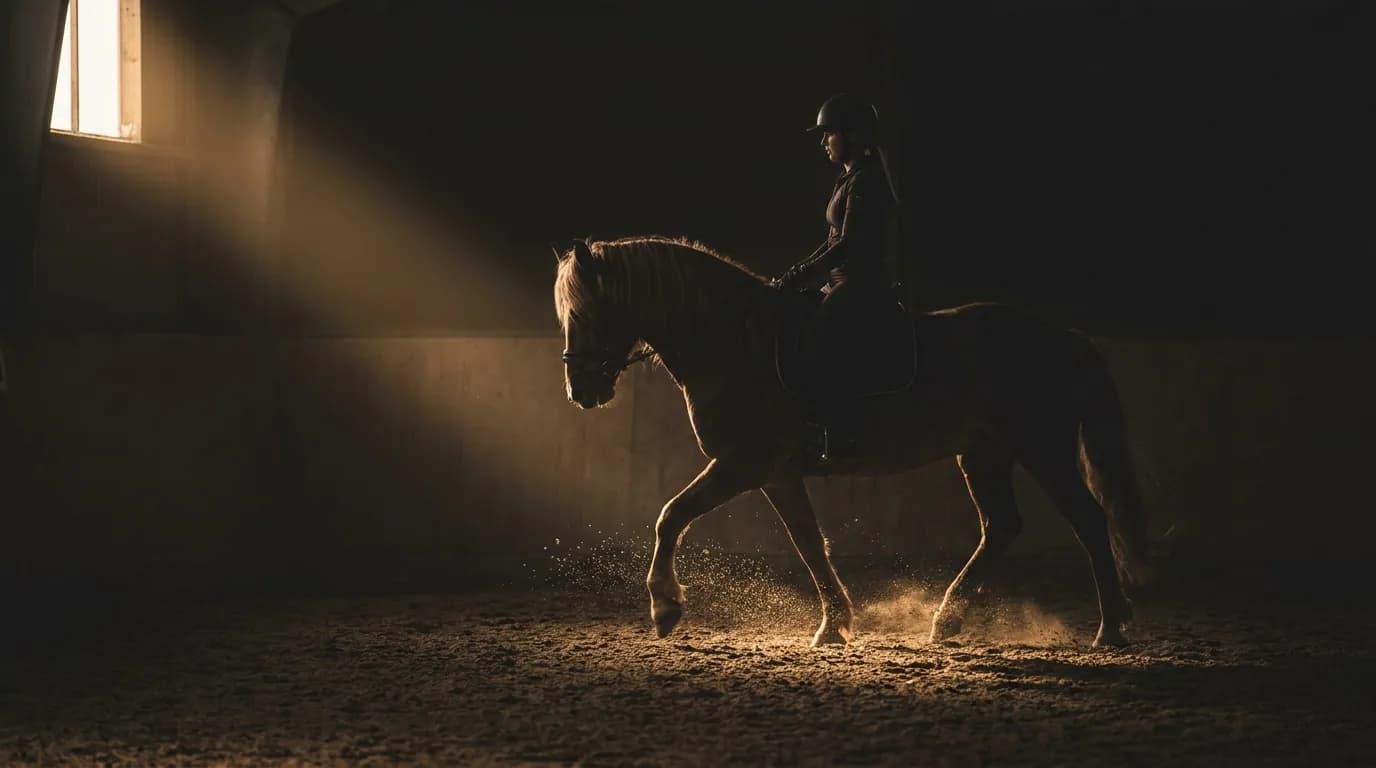
No term of the training scale invites misunderstanding as much as impulsion. Because impulsive horses appear ground-covering and energetic, the fallacy is near that more tempo means more impulsion. The opposite is often the case. Impulsion is not haste, not racing, not running away. It is the energy of the pushing-off hindquarters, which is taken up over a relaxed, swinging back and carried forward through the whole body — the impulsion of the classical riding doctrine.
The difference is palpable and visible. A hasty horse flees forward, runs on the forehand, shortens the steps and loses the moment of suspension. An impulsive horse, by contrast, lingers a moment longer in the air, steps clearly under the centre of gravity and transfers every step elastically over the back into the contact. More impulsion means not faster, but more expressive at a constant rhythm.
Why only in fourth place
Impulsion stands in the scale in fourth place, and that with compelling logic. It presupposes that the first three stages are in place. Without rhythm there is no even energy that could be transferred. Without suppleness the thrust jams in the firm back instead of swinging through. Without contact the forward-carried power can arrive nowhere — it dissipates instead of closing at the hand. Impulsion is therefore no separate training step that one adds, but the result of a chain of movement that finally runs through freely from back to front.
For the same reason impulsion is only possible in trot and canter, never in walk. Impulsion lives from the moment of suspension — that instant in which no leg touches the ground and the springing energy of the movement becomes visible. The walk, as a four-beat gait, has no moment of suspension; it can be diligent, ground-covering and flowing, but not impulsive in the sense of the scale. Whoever seeks impulsion in the walk falsifies the rhythm by urging the horse to hurry.
The signs of genuine impulsion
Genuine impulsion is readable. The movement becomes ground-covering, elastic and even, with a clear, well-visible moment of suspension. The back swings visibly up and down and carries the rider softly along; the horse invites sitting instead of jolting through. The hind legs step diligently and energetically under the centre of gravity, and the energy runs springily forward through — into a calm, constant contact. The rhythm thereby remains unchanged. Precisely here genuine impulsion parts from haste: if the rhythm accelerates, the horse falls onto the forehand or shortens the moment of suspension, then it has not become more impulsive, but faster — and thus poorer in carrying power.
“The hindquarters are the engine, the back the bridge, the hand the receiver — impulsion is nothing other than this one power, unbroken from back to front.”
A widespread confusion with consequences: if impulsion is equated with tempo and the horse is driven faster, the suppleness is lost — the back jams, the moment of suspension disappears, the horse hurries on the forehand. More impulsion never arises through urging forward, but through a more energetic, further under-stepping push-off of the hindquarters at a calm rhythm. When in doubt the rule is: rather slower and carrying than faster and fleeing.
Here the FN scale meets the classical tradition. Steinbrecht demands in the Gymnasium of the Horse to ride the horse forward and to straighten it — forward not in the sense of fast, but in the sense of a movement honestly carrying from the hindquarters. On this energy everything further builds: only the even, two-sided straightness allows the impulsion to be distributed equally to both hind legs, and only the thus collected impulsion can in the collection direct itself increasingly upward instead of forward. Impulsion is thus the stage at which thrust gradually begins to transform into carrying power.
Whoever measures impulsion by tempo loses it. Whoever lets it arise from a rhythmically pure, supple horse stepping up to the hand and resists the temptation to urge forward gains a movement that the horse itself carries — expressive, elastic, and load-bearing enough for everything that comes after it.
Sources
Usage note
This content is for information and education. It does not replace veterinary diagnosis or treatment. If your horse shows signs of illness, consult a veterinarian.
Keep reading
Summer eczema — why the skin is rarely where it starts
The reaction to the midge bite is the visible part. What lies beneath it decides the course.
HealthGrowing old without looking old — what really counts in the senior
Many complaints that pass for age-related are not. A look at what can be influenced.
HealthWhen the coat whispers — what the coat change reveals about the metabolism
Twice a year the horse rebuilds its entire coat. What happens in the metabolism while it does — and which signs can be read.