

Understanding mud fever — why pastern eczema has many causes
Wet and mud, bacteria, mites and a feather-related moist milieu: mud fever is rarely a single problem. Why keeping the pastern dry stands at the centre and why feathered breeds are more often affected.
Equiterna Redaktion
Veterinarian · Sports medicine
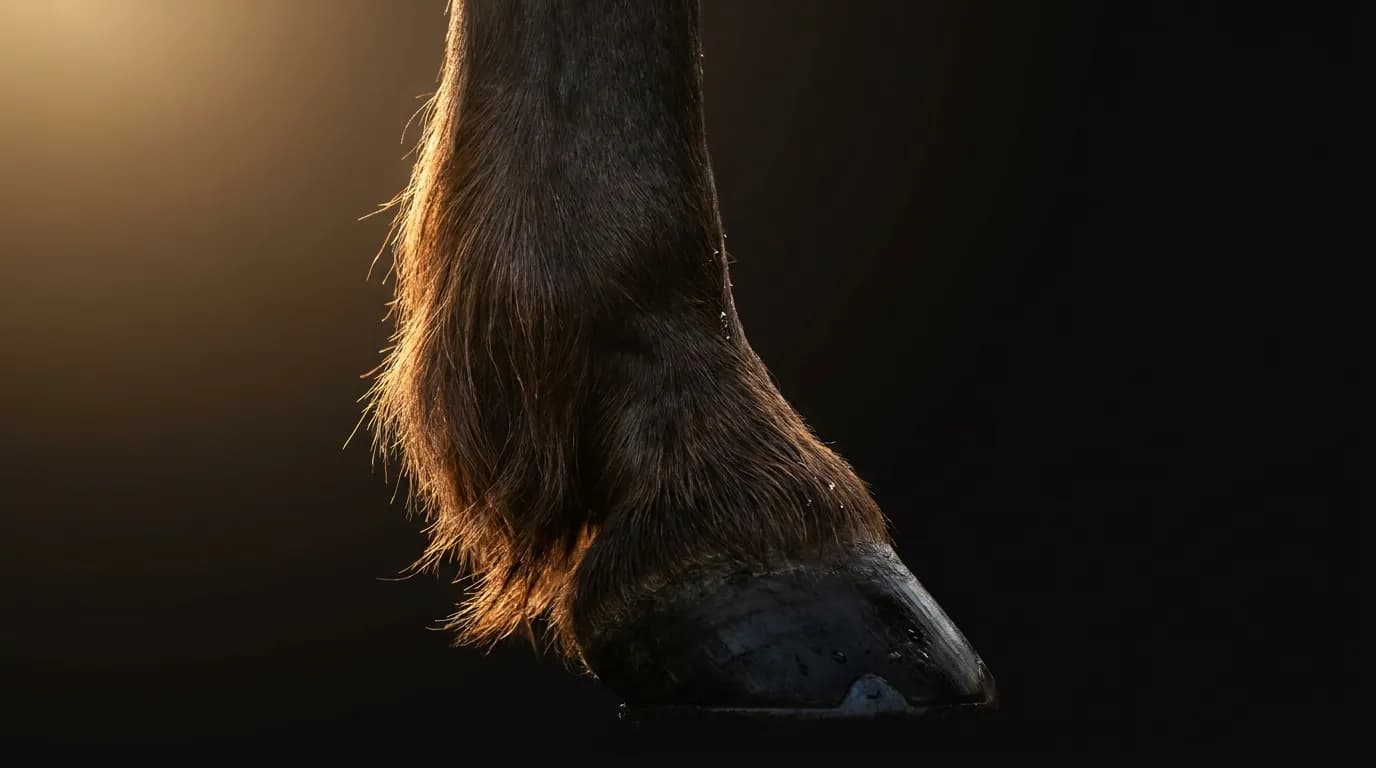
Mud fever — technically termed equine pastern eczema or pastern dermatitis — is no disease entity of its own with a single cause, but a reaction pattern of the skin in the pastern fold. It is exactly this that makes it so stubborn: behind the same picture of redness, scales, crusts and weeping spots can lie very different triggers that often amplify each other.
A multifactorial event
At the beginning there is usually a damaged skin barrier. Persistent wet and mud soften the skin, small cracks develop, and through these portals of entry pathogens settle — often the bacterium Dermatophilus congolensis, plus staphylococci, sometimes fungi. In other cases Chorioptes mange mites are the driving force: they irritate the skin of the pastern fold and thus first pave the way for the bacterial colonisation. Contact irritants and, consequently, the photosensitivity of unpigmented skin also play into it. This multicausality explains why a single agent rarely suffices.
The common denominator of almost all triggers is moisture. A persistently wet pastern fold is the ideal breeding ground — for softened skin just as for bacteria and mites. Therefore the management revolves at its core around a single variable: keeping the pastern dry.
Why feathered breeds are more often affected
Striking is the clustering in breeds with abundant fetlock feather such as Irish Cob (Tinker) and Friesian. The dense feather holds wet and dirt directly against the skin and creates a permanently moist, poorly drying microclimate — a milieu in which pathogens and mites feel especially comfortable. In some heavily feathered lines a predisposition to chronic lymphatic swelling of the lower legs comes on top, which further aggravates the problem. Careful trimming of the feather for drying and consistent hygiene are central adjusting screws here.
In practice, management means: avoid muddy passages and persistent wet, let the pastern dry clean and above all completely after load, do not constantly wash it wet, and do not further damage the skin by aggressive scrubbing. Dry lying and standing areas are often more effective than any agent on the already irritated skin.
“Mud fever is rarely a question of the right pot on the skin. It is almost always a question of whether the pastern ever properly dries off.”
At the feeding level, two trace elements of skin metabolism come into view. Zinc is a cofactor of numerous enzymes of skin regeneration and keratin formation — the structural proteins of horn and skin barrier. Copper works closely together with zinc in connective tissue and keratin metabolism, which is why both are always considered in relation to each other. A balanced supply is a nutritional building block of a resilient skin barrier — no mud fever agent and no substitute for dry husbandry. Whether the overall ration shows a real gap here is clarified by the ration assessment, not by the skin spot.
Context: deep, painful, heavily weeping or chronically recurring forms as well as the suspicion of mite involvement belong in veterinary clarification — also for the targeted determination of the pathogen. This article describes the clinical picture and the hygiene and husbandry management; it makes no diagnosis, gives no treatment instruction and no healing promise.
Sources
Usage note
This content is for information and education. It does not replace veterinary diagnosis or treatment. If your horse shows signs of illness, consult a veterinarian.
Keep reading
Summer eczema — why the skin is rarely where it starts
The reaction to the midge bite is the visible part. What lies beneath it decides the course.
HealthGrowing old without looking old — what really counts in the senior
Many complaints that pass for age-related are not. A look at what can be influenced.
HealthWhen the coat whispers — what the coat change reveals about the metabolism
Twice a year the horse rebuilds its entire coat. What happens in the metabolism while it does — and which signs can be read.