Headshaking — when the head tossing is a nerve pain and not a vice
Headshaking is usually not a behavioural problem, but often a facial pain mediated via the facial nerve. Why the abrupt, involuntary head flinging is a symptom complex requiring exclusion diagnostics — and why light and season so frequently appear as triggers.
Equiterna Redaktion
Veterinarian · Internal medicine
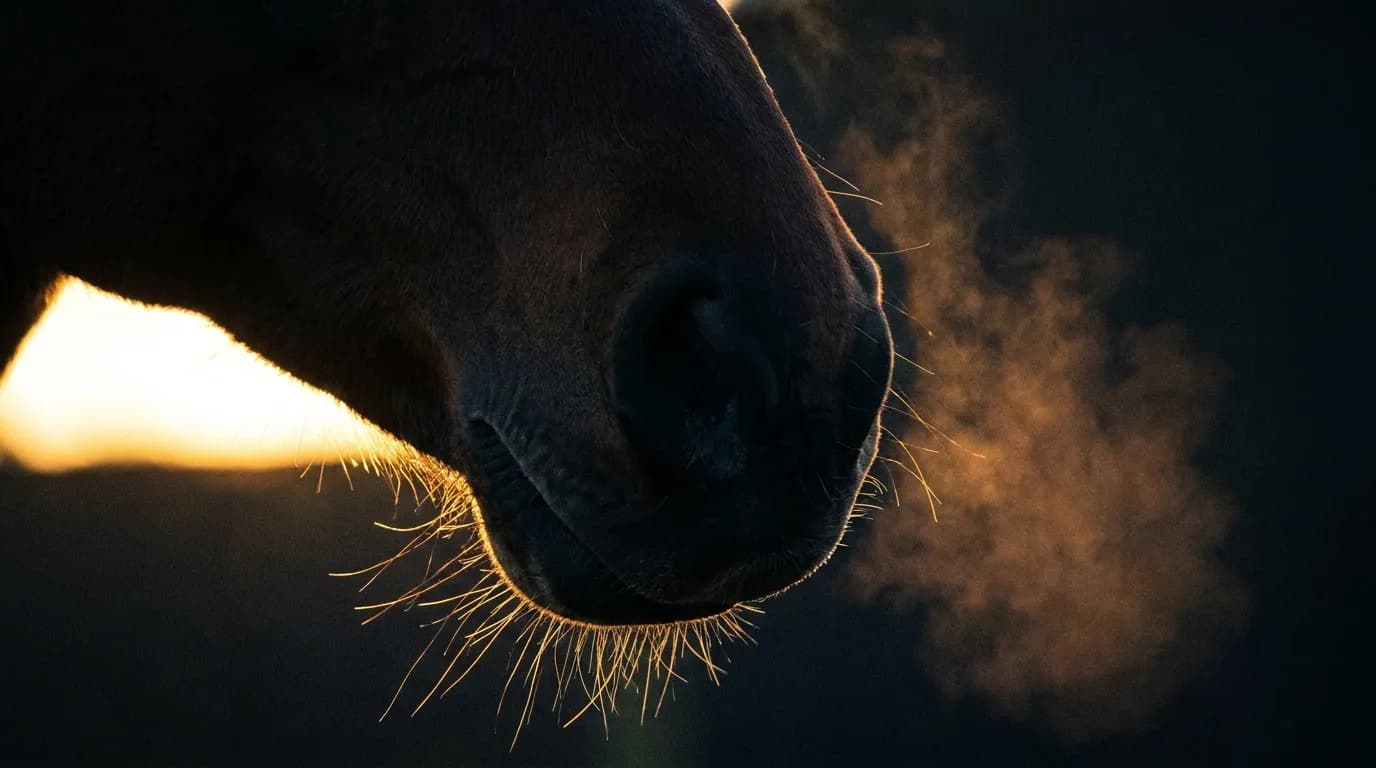
Headshaking describes an abrupt, involuntary and repetitive flinging or striking of the head — usually upward, often accompanied by snorting, wrinkling of the nose, rubbing the nose against objects or against the horse's own leg. Characteristic is that the movements shoot in suddenly, as if the horse were reacting to a sting or a tingling that no one sees. Precisely this impression leads to the core of the understanding: in many cases it is not a vice under saddle, but a real, physical stimulus.
Why the facial nerve is at the centre
A considerable part of the severe cases is today classified as trigeminal-mediated. The trigeminal nerve is the large facial nerve that controls, among other things, the sensation of the nose, mouth and face. In the trigeminal-mediated form this nerve appears to be hypersensitive and to transmit stimuli as a painful burning, tingling or stinging, although no external injury is present — a neuropathic facial pain, comparable to nerve pain in humans. This explains the sudden, seemingly groundless onset of the head movements: the horse reacts to a pain stimulus that arises in the nerve itself.
Light and season as triggers
Strikingly often, owners report a seasonal pattern: the signs begin in spring or summer and subside again in autumn, in part year after year almost on the same date. In a proportion of the horses a relation to light can additionally be observed — the so-called photic form. Here bright sunlight intensifies the symptoms, while covering the eyes, dusk or darkness can clearly ease them. It is suspected that light stimuli, via a cross-connection, also help to set off the hypersensitive facial nerve — a mechanism that resembles light-triggered sneezing in humans.
“The horse does not shake its head because it does not want to — it shakes because something in its face is burning that we cannot see. This reinterpretation from behavioural problem to nerve pain changes everything in the handling of the horse.”
A symptom complex — and why exclusion diagnostics is indispensable
As striking as the picture is, headshaking is by no means a finished diagnosis. The same head striking can have many causes that must first be clarified: problems with the teeth or sinuses, diseases of the ears or guttural pouches, eye disorders, unsuitable equipment with pressure on the poll or on the bit, pain in the back or simply the rider's influence. Only once these sources have been systematically excluded does trigeminal-mediated headshaking remain as the classification. This is why one speaks of a symptom complex requiring exclusion diagnostics — and why the clarification belongs imperatively in veterinary hands, often with examination of mouth, eyes, ears and head as well as imaging procedures.
Reduce triggers instead of suppressing symptoms
Because the nerve cannot simply be switched off, management first aims to reduce known triggers. In light-sensitive horses, eye protection from light or avoiding glaring midday sun can help; in horses that react to stimuli at the nose, nose nets are used that give a gentle, distracting stimulus to the nostril entrance. Such measures do not cure the underlying hypersensitivity, but they do provide relief for a proportion of the horses. Which triggers play a role in an individual horse and which measure is sensible can only be assessed individually after a veterinary examination.
Classification: abrupt, recurrent head striking without a recognisable external cause belongs in veterinary clarification — also in order to exclude teeth, ears, eyes, equipment and sources of pain. This article explains the clinical picture and possible triggers; it does not make a diagnosis, gives no therapy instruction and no promise of cure.
Sources
Usage note
This content is for information and education. It does not replace veterinary diagnosis or treatment. If your horse shows signs of illness, consult a veterinarian.
Keep reading
Summer eczema — why the skin is rarely where it starts
The reaction to the midge bite is the visible part. What lies beneath it decides the course.
HealthGrowing old without looking old — what really counts in the senior
Many complaints that pass for age-related are not. A look at what can be influenced.
HealthWhen the coat whispers — what the coat change reveals about the metabolism
Twice a year the horse rebuilds its entire coat. What happens in the metabolism while it does — and which signs can be read.