Straightness — the natural crookedness and the path to evenness
Almost every horse comes into the world with an innate handedness: a hollow and a stiff side. The fifth stage of the training scale, straightness, answers this inequality not with coercion, but with patient, two-sided gymnasticising.
Equiterna Redaktion
Groundwork & Centered Riding
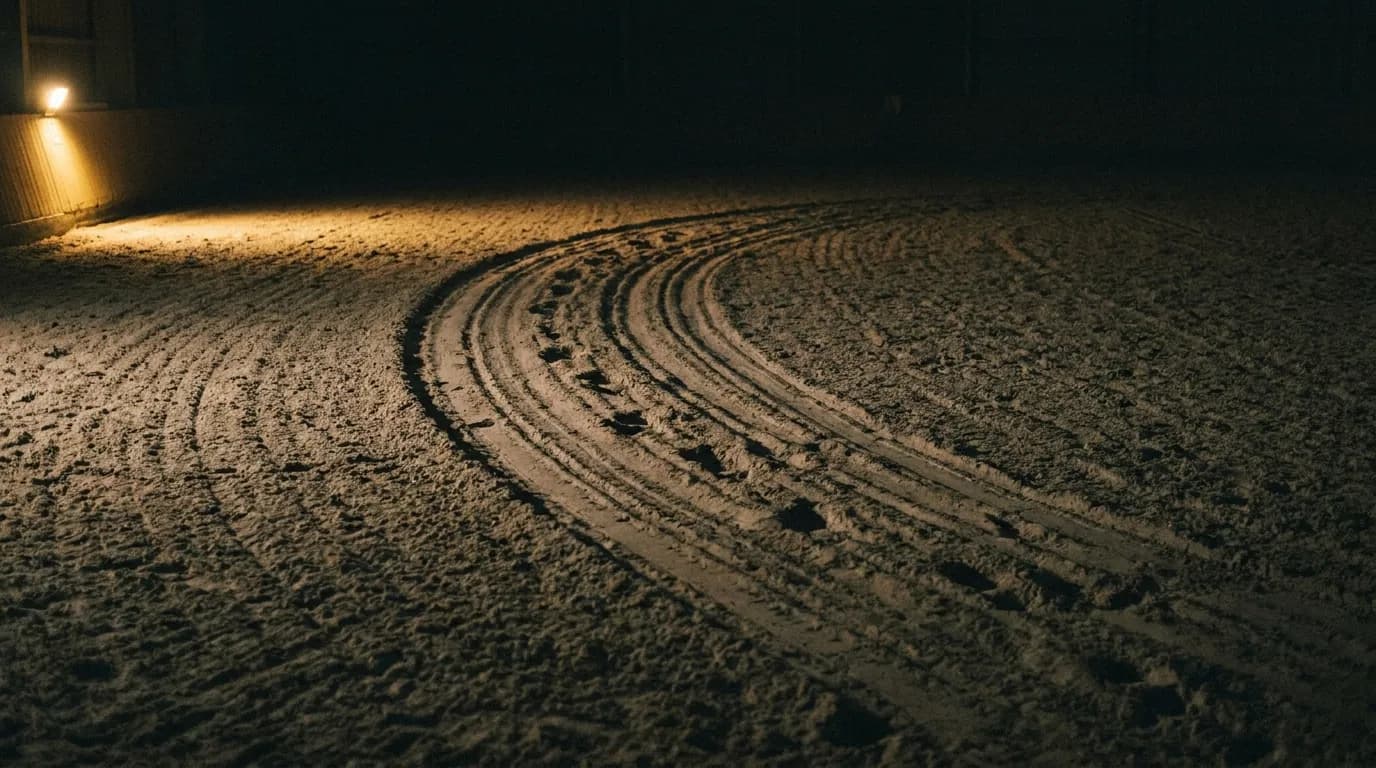
Whoever observes a young horse unbiasedly rarely sees it go really straight. On one hand it positions itself willingly, bends softly, seeks the contact. On the other it seems stiffer, falls over the outer shoulder, does not like to accept the inner leg. That is no disobedience and no training fault — it is the natural crookedness with which nearly every horse comes into the world.
Just as humans are right- or left-handed, the horse too has a preferred side. One speaks of a hollow side, towards which the horse easily turns, and a stiff side, on which it stays firmer and straighter. This handedness shapes from the start how the horse distributes its weight and how its hind legs meet the ground.
What follows from the crookedness
The crookedness is more than a preference for one hand. It leads to the two body halves working unevenly. The horse loads the forehand and the hind legs to a different degree, and one hind leg steps less far under the centre of gravity than the other. Often the hindquarters push to the inside or outside instead of following the track of the forelegs.
It becomes palpable in the contact. On the hollow side the horse hardly accepts the outer rein and pushes over the shoulder, on the stiff side it tends to lean firmly. A steady, even connection to both reins — the goal of every contact — cannot be established against the crookedness. The inequality of the hindquarters carries on into the mouth.
Straightening means: gymnasticise both sides equally
Straightness does not mean to force the horse rigidly onto a line. It means to align the weaker and the stronger side to each other over time, so that both hind legs step equally far and equally carrying under the centre of gravity. The horse is then straight when the hind legs step into the track of the same-side forelegs — on the straight line as on the bent track.
This is achieved through careful, side-equal work: through consistent riding on both hands, through bending work on the circle and bent lines, and later through the loosening and straightening lateral movements such as shoulder-in and travers, which strengthen the hollow side and make the stiff side more supple. The classical riding doctrine therefore understands shoulder-in since La Gueriniere as one of the most important lessons of all.
“Ride your horse forward and straighten it.”
This dictum, which in the German-speaking area is closely connected with Gustav Steinbrecht's Gymnasium of the Horse and his school, captures two thoughts in one sentence. The forward supplies the thrust and the diligence out of which straightening is at all possible — a hesitant horse cannot be made straight. And the straightening orders this force so that it flows evenly through both body halves. Both belong inseparably together.
Practice: straightness is no one-off act and no lesson chapter that one ticks off. It begins on the first training day with even work on both hands and runs through every session. Whoever rides again and again on the easier hand because it feels better amplifies the crookedness instead of dissolving it.
In the training scale, straightness stands in fifth place, immediately before collection — and that is no coincidence. Collection demands that both hind legs take up equal load. A crooked horse cannot honestly collect, because one hind leg evades the carrying work. Straightness is thus the prerequisite for everything further succeeding evenly and without overloading one side.
Sources
Usage note
This content is for information and education. It does not replace veterinary diagnosis or treatment. If your horse shows signs of illness, consult a veterinarian.
Keep reading
Summer eczema — why the skin is rarely where it starts
The reaction to the midge bite is the visible part. What lies beneath it decides the course.
HealthGrowing old without looking old — what really counts in the senior
Many complaints that pass for age-related are not. A look at what can be influenced.
HealthWhen the coat whispers — what the coat change reveals about the metabolism
Twice a year the horse rebuilds its entire coat. What happens in the metabolism while it does — and which signs can be read.