
Foal growth and minerals — even beats fast
Copper, zinc and a balanced calcium-phosphorus ratio accompany the skeletal development of the young horse. Why not the fastest, but the even growth is the key.
Equiterna Redaktion
Equine nutritionist · NRC / GfE
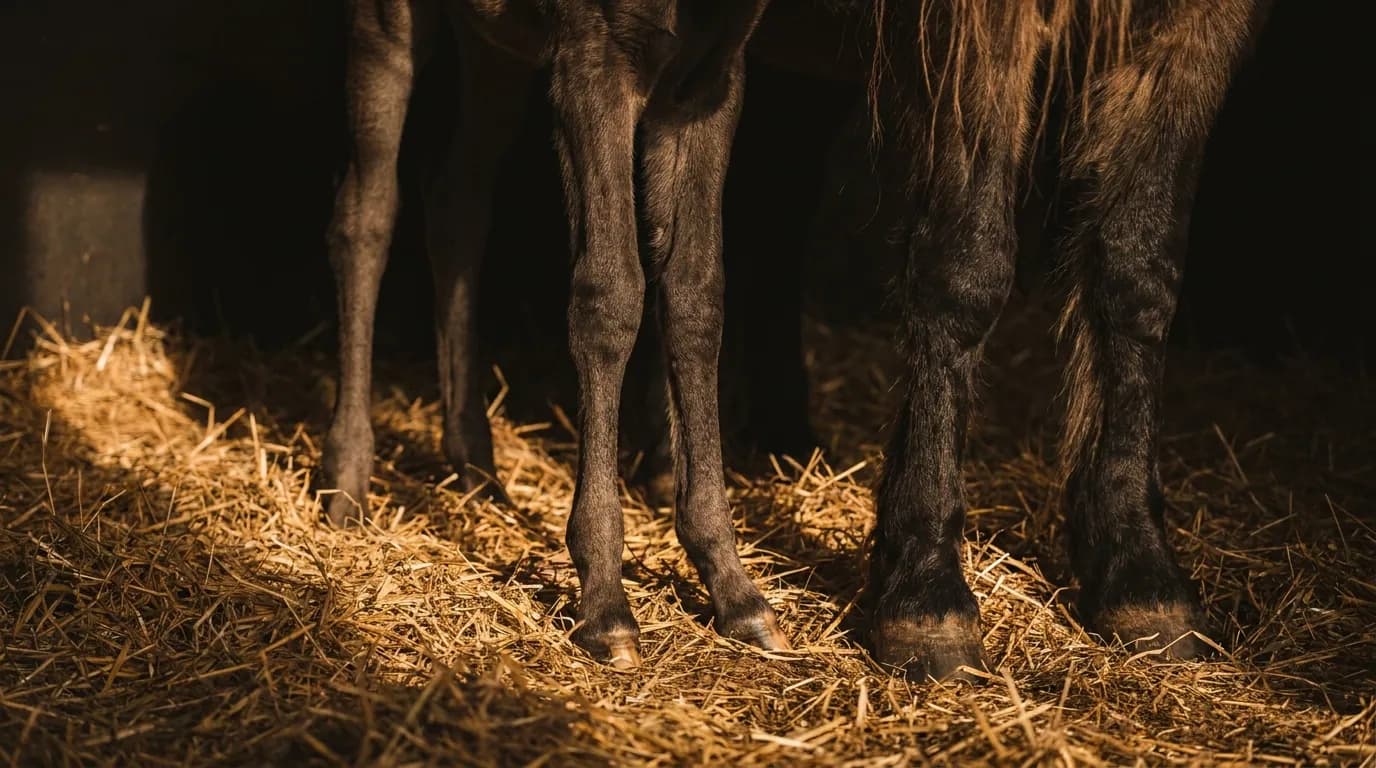
In the first months of life and in the first year the horse lays down the greater part of its skeletal development. This makes this phase nutritionally sensitive like no other — and it makes a widespread reflex problematic: to raise as swiftly as possible a large, sturdy youngster. For a resilient foundation what counts is not the pace, but the evenness of the growth.
Why abrupt growth is a risk
Bone and cartilage mature in an ordered sequence. An energy excess in the ration — for example through plentiful concentrate feed — can trigger growth spurts that overtake this maturation. In the specialist literature an excess of energy and abrupt growth jumps are discussed as factors in the context of the developmental disorders of the skeleton (Developmental Orthopaedic Disease, DOD, to which osteochondrosis also belongs). This is an editorially classifiable connection from the research, not a mechanism that a feed could control or a disorder could cure.
Copper is cofactor of lysyl oxidase, an enzyme that catalyses the cross-linking of collagen and elastin in the connective tissue — thus directly involved in the stability of cartilage and bone matrix. In a controlled work by Knight and colleagues (Equine Veterinary Journal 1990) foals of copper-poor fed groups showed clearly more cartilage and joint findings than copper-supplemented animals. Zinc acts in a flanking role in keratinisation and as cofactor of numerous enzymes. Both trace elements deserve particular attention in rearing.
The calcium-phosphorus ratio
In the growing horse it depends not only on the absolute quantities of calcium and phosphorus, but on their ratio to one another. A range of about 1.5 to 2 parts of calcium to 1 part of phosphorus serves as orientation; a phosphorus excess — for example through much grain with scarce forage — can disturb the calcium utilisation. Precisely in the growth phase this balance is no detail, but the basis of the bone mineralisation.
“A foal does not have to grow big fast. It has to grow big evenly — the bone forgives pace worse than patience.”
The supply of the foal moreover begins before birth: the copper status of the pregnant mare shapes the liver stores of the newborn, which itself receives only limited copper via the milk. A requirement-appropriate supply of the broodmare in the last third of pregnancy is thereby part of the foal supply — not only the supplementary feeding of the weaned young horse.
Important for classification: developmental disorders of the skeleton and osteochondrosis are veterinary diagnoses with several influencing factors — genetics, loading and feeding together. Mineral feed and a balanced rearing ration are supply and prevention via complementary feed, no promise of cure or protection. The concrete growth and ration planning — including energy dosing and trace element quantities — belongs in qualified feeding and veterinary consulting.
The most robust strategy is therefore unspectacular: plenty of structure-rich forage, a mineral feed attuned to rearing with sufficient copper and zinc, a calcium-phosphorus ratio kept in view — and the willingness to throttle energy rather than to push it. Evenly grown young horses are the goal, not the largest.
Sources
Usage note
This content is for information and education. It does not replace veterinary diagnosis or treatment. If your horse shows signs of illness, consult a veterinarian.
Keep reading
Summer eczema — why the skin is rarely where it starts
The reaction to the midge bite is the visible part. What lies beneath it decides the course.
HealthGrowing old without looking old — what really counts in the senior
Many complaints that pass for age-related are not. A look at what can be influenced.
HealthWhen the coat whispers — what the coat change reveals about the metabolism
Twice a year the horse rebuilds its entire coat. What happens in the metabolism while it does — and which signs can be read.