
The training scale — why suppleness is the gate to everything
Rhythm, suppleness, contact, impulsion, straightness, collection: the six stages are no curriculum to work through, but a connected system. At the centre stands one stage that carries everything.
Equiterna Redaktion
Groundwork & Centered Riding
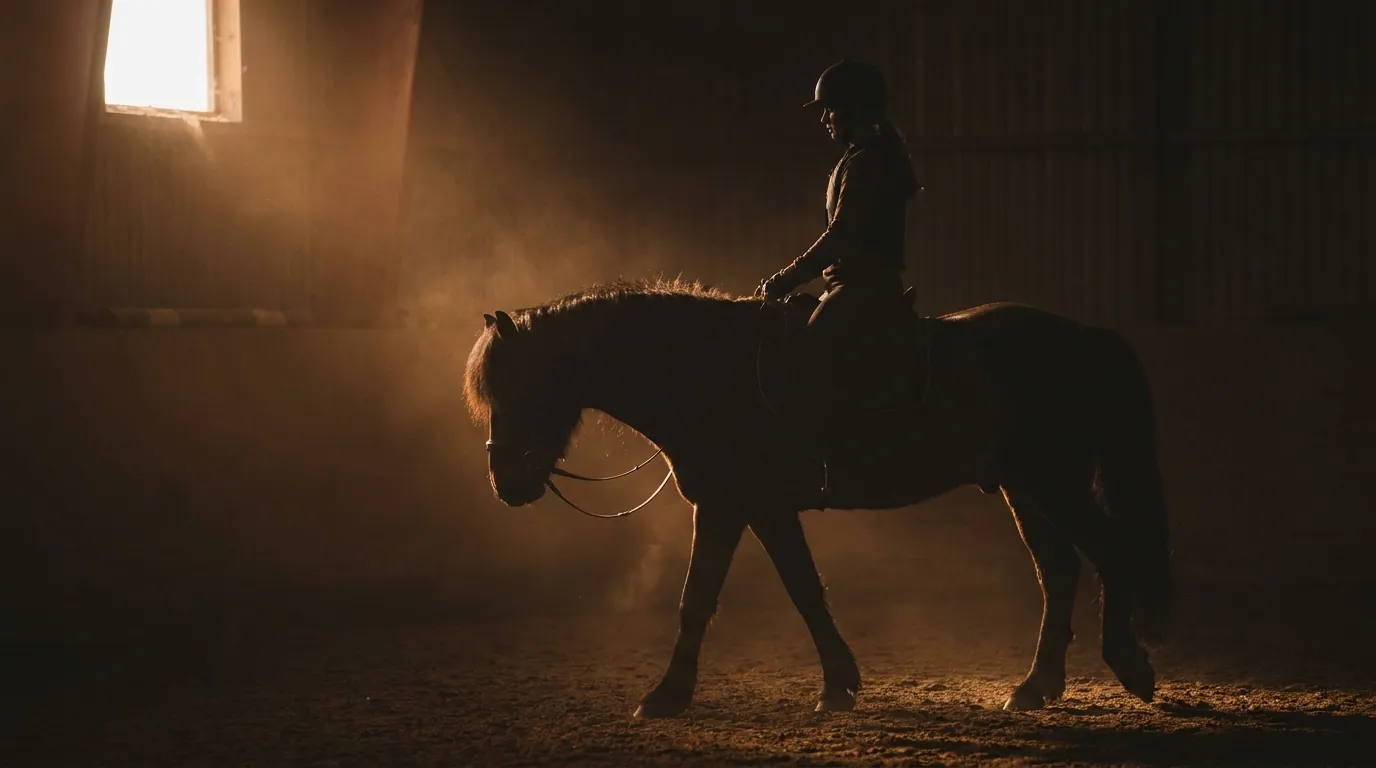
The training scale of the FN names six terms: rhythm, suppleness, contact, impulsion, straightness and collection. Whoever reads them as a staircase that one climbs step by step and leaves behind misunderstands them. It is rather an arc that spans across the whole training — and in which each term carries the others along.
The first three stages form the familiarisation and development phase, the last three the phase of carrying power and collection. What holds the whole scale together is throughness: the willingness of the horse to let the aids run forward and over the back through the body without resistance. And the gate to throughness is suppleness.
Rhythm comes first — suppleness makes it load-bearing
The rhythm, that is the even temporal and spatial structuring of the movement in walk, trot and canter, stands at the beginning. But a rhythm that arises under tension is hectic or held back, never load-bearing. Only when the horse lets go inwardly and outwardly does the rhythm become round and even. Therefore the first two stages mesh together: without suppleness no reliable rhythm.
What suppleness really means
Suppleness is two things at once, mental and physical. Mentally it means a horse that is attentive but not tense, that listens instead of resisting. Physically it means a musculature that can tense and let go again, instead of being permanently firm. Both condition each other: an inwardly tense horse cannot give the back, and a tense back keeps the restlessness awake.
The signs can be read when one looks. The back swings and takes up the movement of the rider, instead of pushing it away. The horse chews calmly and seeks the contact forward-downward. The tail swings loosely in the rhythm of the movement, instead of being clamped or lashing. The breathing is even, often accompanied by an audible snorting. None of these signs can be forced — they set in or they do not.
“Without suppleness none of the further stages is honestly reachable — contact becomes holding, impulsion becomes hurry, collection becomes tightness.”
Why everything further hangs on it
The contact, the next stage, is the steady, soft connection between the rider's hand and the horse's mouth. It can only arise when the horse steps up to the hand supplely — a contact against a firm horse is no contact, but a prop. Impulsion in turn is the transmitted thrust of the hindquarters, which without a swinging, supple back does not come through forward in the first place. Thus suppleness runs as a condition through every following stage up to collection.
This insight is old. Already Xenophon holds in his riding doctrine Peri Hippikes that nothing beautiful is to be achieved from the horse under coercion — the horse should go willingly and with grace. The classic French school, from La Gueriniere in the École de Cavalerie into the later tradition, has carried the same thought further in the demand for lightness and ease. The FN scale thus formulates no new principle, but orders a very old one.
Practice: the loosening phase at the beginning of every session serves exactly this one goal. Whoever shortens it to get to the exercise faster builds on a firm back — and often only notices it stages later, when impulsion and collection do not want to carry. Time at the beginning is here no lost time.
The training scale rewards patience and punishes hurry. Suppleness cannot be forced, only invited — and exactly therein lies its value as a measure. A supple horse shows that the communication is right. Everything further builds on it.
Sources
Usage note
This content is for information and education. It does not replace veterinary diagnosis or treatment. If your horse shows signs of illness, consult a veterinarian.
Keep reading
Summer eczema — why the skin is rarely where it starts
The reaction to the midge bite is the visible part. What lies beneath it decides the course.
HealthGrowing old without looking old — what really counts in the senior
Many complaints that pass for age-related are not. A look at what can be influenced.
HealthWhen the coat whispers — what the coat change reveals about the metabolism
Twice a year the horse rebuilds its entire coat. What happens in the metabolism while it does — and which signs can be read.