Contact — the bridge between hindquarters and hand
Contact is the third stage of the training scale and at the same time its most frequently misunderstood term. It is not a matter of the reins but the result of a horse that steps from the hindquarters over the swinging back trustingly up to the hand — from back to front, never the other way round.
Equiterna Redaktion
Groundwork & Centered Riding
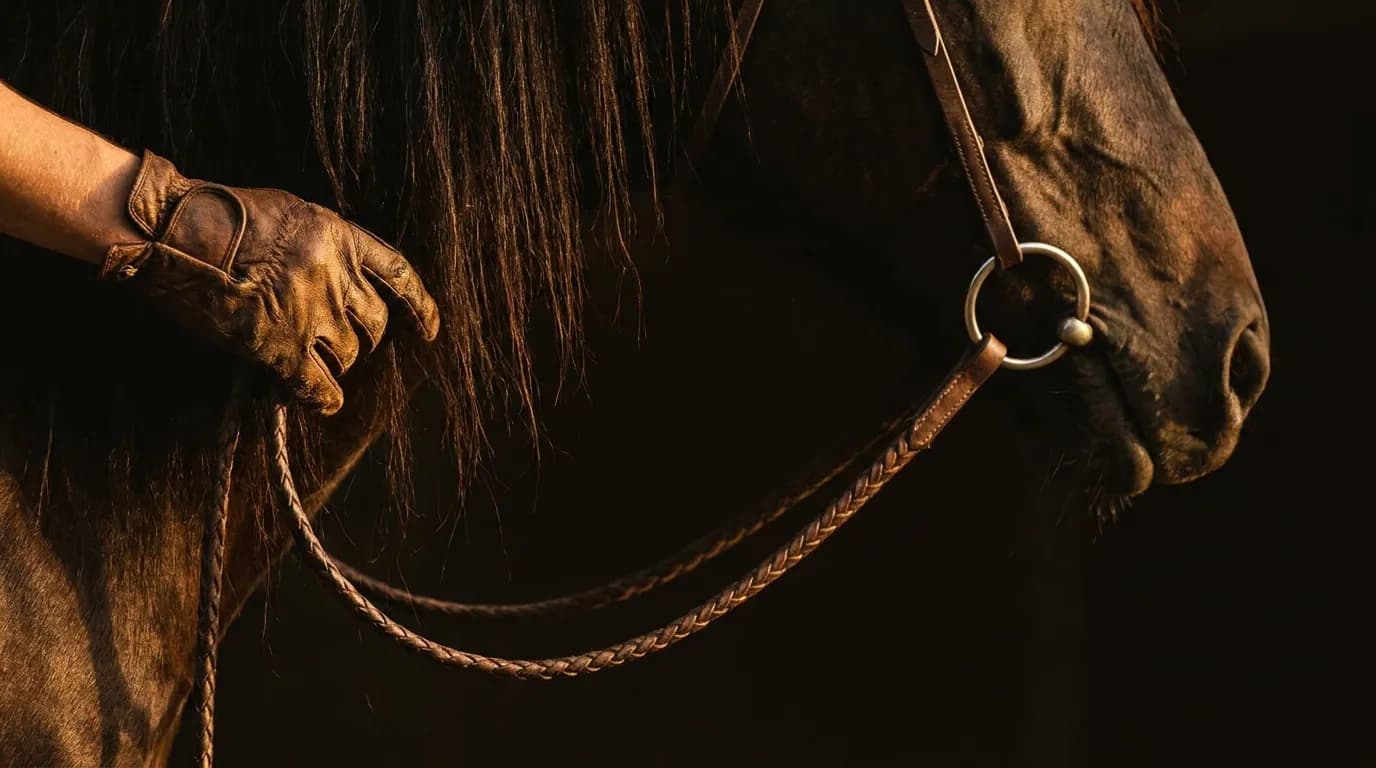
Hardly a term of the training scale is sought so often in the wrong place as the contact. Because it shows itself at the reins, the fallacy is near that it could also be produced there — through shortening, taking up, through a hand that pulls the horse into shape. Exactly that it is not. Contact is the steady, soft connection sought by the horse between rider's hand and horse's mouth, and it arises not in the hand but in the hindquarters.
The path leads from back to front. The hind legs step actively under the centre of gravity, their thrust runs over a relaxed, swinging back through the neck up to the bit. Only when this chain of movement is closed does the horse stretch of its own accord up to the hand and seek the contact. The rider's hand only takes up this stretch — it waits, it receives, it does not produce.
Suppleness is the condition
Contact stands in third place in the scale, immediately after suppleness — and that in a compelling order. A firm horse, tense in the back, cannot let the thrust of its hindquarters through to the front at all; it seeps away in the clamping back. What then arrives at the hand is no honest contact, but at best a support, at worst a holding against one another. Therefore the rule is: without suppleness no contact, only its image.
The signs of genuine contact
An honest contact is readable. The connection is constant and light, without snatching, without dead load in the hand — a living, breathing contact that stays the same at every step. The horse carries its neck of its own accord, stretches trustingly forward to the bit and at any time accepts the offer to follow the mouth forward-downward. A calm, even chewing and a fine foam formation at the mouth show the relaxed chewing activity of a content horse. The nose stands thereby at or slightly in front of the vertical — never behind it.
The last point is the decisive difference. Genuine contact leads the horse up to the hand; the rolling up draws it behind the hand. A horse that goes behind the vertical, rolls up or clamps the neck has not sought the connection but yielded to it — it withdraws from the contact instead of accepting it. The chain of movement from back to front is then interrupted, and the back can no longer swing freely.
“The hand shall receive what the hindquarters send — it shall force nothing and hold nothing.”
Animal welfare classification: the permanent riding behind the vertical — the tight, forced hyperflexion of the neck (Rollkur) — is no contact and no desirable training path. It contradicts the principle of the connection sought from back to front, voluntarily, and is clearly rejected from an animal welfare point of view. Contact invites the horse up to the hand; it does not force it behind.
Here the FN scale meets the classical riding doctrine, which has always demanded the light hand and the timely yielding. La Guériniere demands in the École de Cavalerie a hand that feels and yields instead of pulling; the German school around Steinbrecht formulates the same order in the dictum to ride the horse forward and let it step up to the hand. Contact is in both traditions no end in itself, but a bridge: over it the impulsion of the hindquarters is carried to the front, and on it straightness builds the even connection to both reins.
Whoever seeks the contact at the hand loses it. Whoever lets it arise from a supple, diligently from-behind-stepping horse and only receives with a calm, giving hand wins a connection that the horse carries itself — and on which everything further can honestly build.
Sources
Usage note
This content is for information and education. It does not replace veterinary diagnosis or treatment. If your horse shows signs of illness, consult a veterinarian.
Keep reading
Summer eczema — why the skin is rarely where it starts
The reaction to the midge bite is the visible part. What lies beneath it decides the course.
HealthGrowing old without looking old — what really counts in the senior
Many complaints that pass for age-related are not. A look at what can be influenced.
HealthWhen the coat whispers — what the coat change reveals about the metabolism
Twice a year the horse rebuilds its entire coat. What happens in the metabolism while it does — and which signs can be read.