

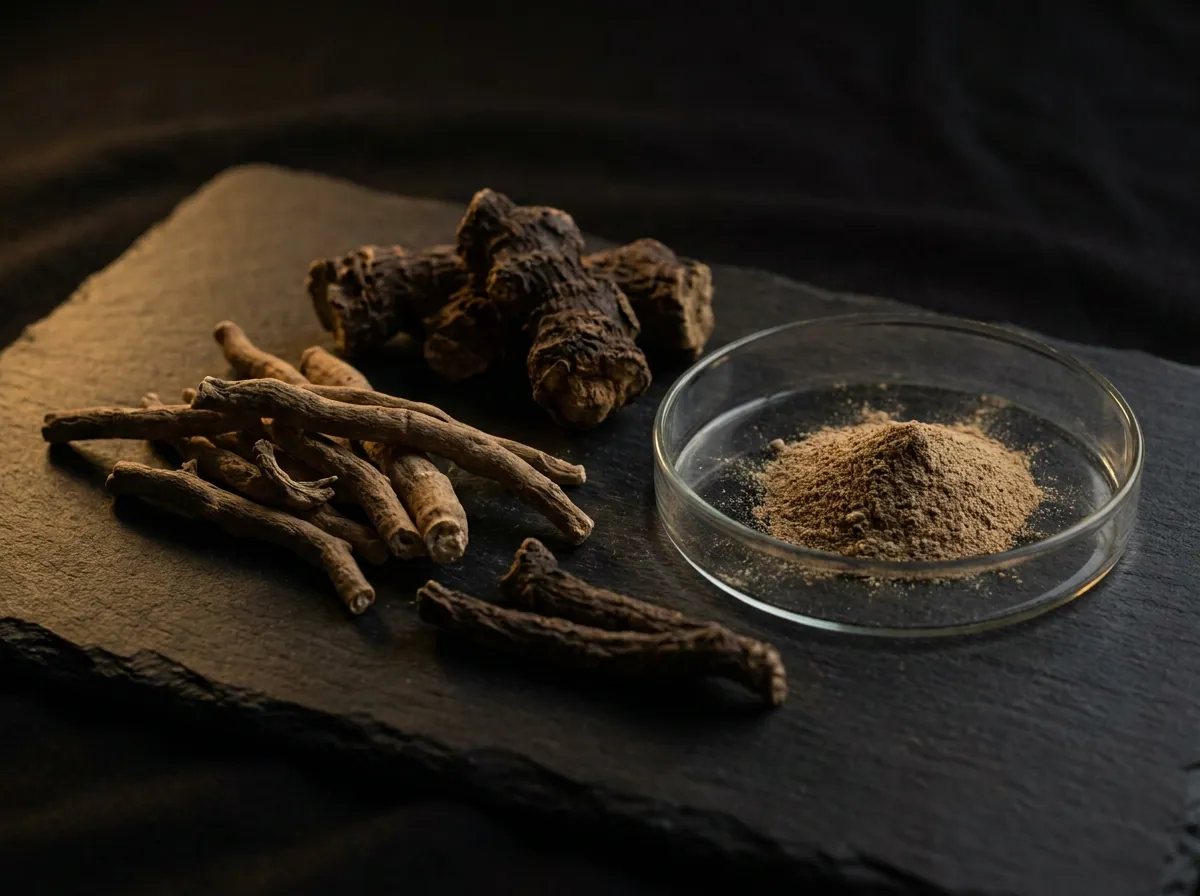
Astragalus (Tragant)
Astragalus membranaceus · Huang Qi · Astragali Radix · Mongolischer Tragant
Mechanism
Leitsubstanzen sind Astragalus-Polysaccharide (APS), Cycloartan-Triterpensaponine (v. a. Astragalosid IV) und Flavonoide (Fu et al., Phytother Res 2014, PMID 25087616). Astragalus-Polysaccharide zeigen in Zell- und Tiermodellen immunmodulierende Effekte, u. a. Aktivierung von Makrophagen und natuerlichen Killerzellen sowie Modulation von Zytokinen (Zheng et al., Rev Pharmacol Action of Astragalus Polysaccharide 2020, PMC7105737). Astragalosid IV wird protektive Wirkung auf Herz-Kreislauf-, Nieren- und Nervengewebe ueber antioxidative und antiinflammatorische Signalwege zugeschrieben (Review Astragaloside IV, ScienceDirect 2019). Die Datenlage beruht ganz ueberwiegend auf In-vitro- und Nagerstudien; kontrollierte klinische oder pharmakokinetische Studien beim Pferd fehlen. Beim Pferd ist der Einsatz als Ergaenzungsfuttermittel damit traditionell/extrapoliert zu bewerten, nicht als belegte Immuntherapie. Wichtig: Verwechslungsrisiko mit swainsonin-haltigen, neurotoxischen Astragalus-Arten (Locoweed) - nur botanisch definierte A. membranaceus-Ware.
Cautions
- · Immunmodulierend: theoretisch Vorsicht bei Autoimmunkontext und begleitender immunsuppressiver/Kortikosteroid-Therapie
- · Verwechslungs-/Kontaminationsrisiko mit toxischen (swainsonin-haltigen) Astragalus-Arten - nur eindeutig deklarierte A. membranaceus-Droge
- · Tragende/laktierende Stuten: mangels equiner Daten meiden
- · FEI: allgemeine Warnung vor Kraeuterprodukten unbekannter Zusammensetzung - vor Wettkampf abklaeren
Sources
Usage note
This content is for information and education. It does not replace veterinary diagnosis or treatment. If your horse shows signs of illness, consult a veterinarian.
“Nothing forced can ever be beautiful.”
Equiterna is an intermediary platform for equine knowledge, marketplace and tools — not a veterinary-medicines dealer, veterinary practice or pharmacy. Compound information is study-attributed and free of healing claims. Legal framework: Regulation (EU) 2019/6 / TAMG (DE/AT), Feed Regulation (EC) 767/2009, FEI Prohibited Substances List, HWG.