Natural horsemanship
Feel, timing, balance — communication through body language (Dorrance, Hunt, Brannaman).
The bond across all riding styles: animal welfare and biomechanics — method-neutral, no ranking.
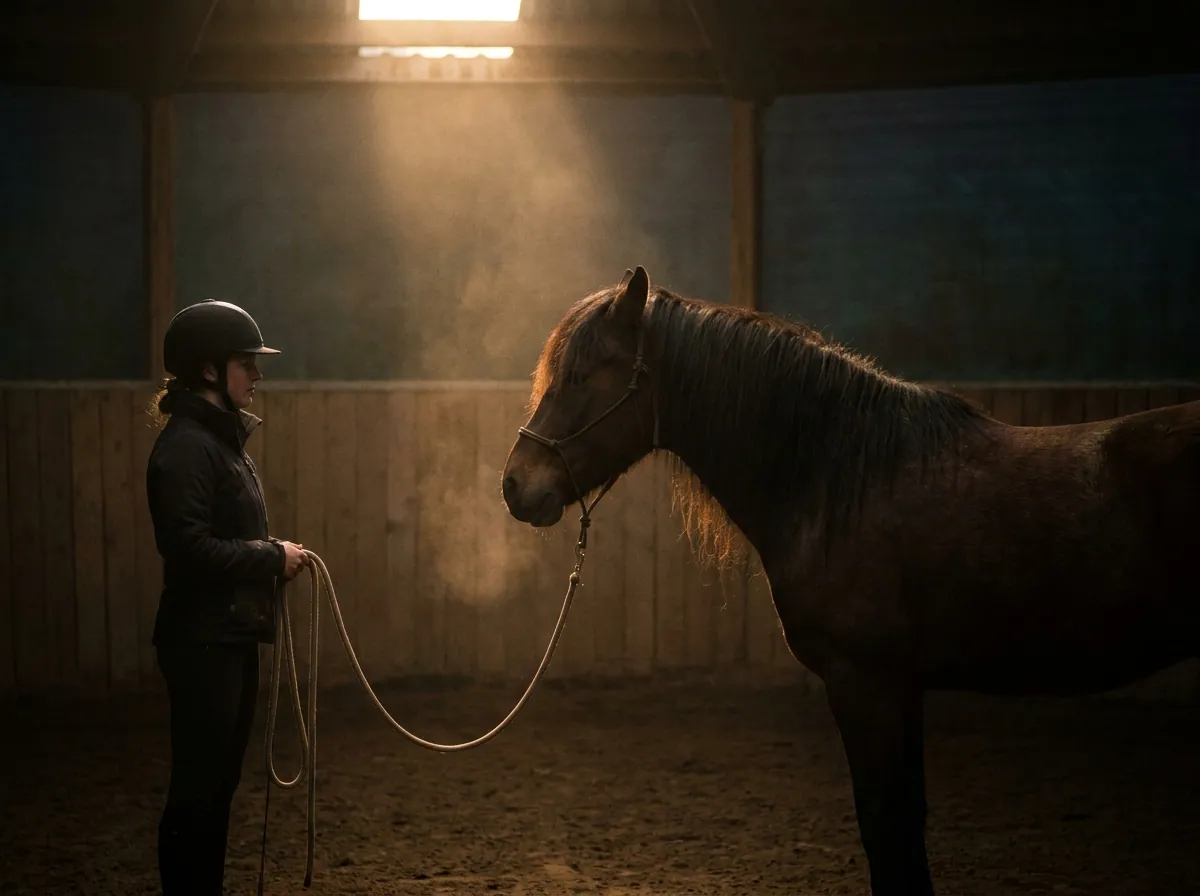
Natural Horsemanship does not denote a single method but an attitude grown in the American West that understands the horse first as a sentient being with its own perception, and approaches training as communication rather than subjugation. From the working riding of the Californian Vaqueros arose the idea of metering pressure and release so finely that the horse seeks out and finds the correct answer on its own. Its contribution to a learning-oriented education lies in the consistent application of learning-psychology principles and in the primacy of groundwork as the foundation of trust and understanding. Like every popular school it has its commercialized excesses too -- the ethologically sound principles remain untouched by them.
Vaquero Tradition
Californian School
Out of Spanish-Mexican working riding arises the patient path from the Bosal through the Two-Rein to the Spade Bit. Years instead of months -- finesse as the goal, not speed.
Tom Dorrance
True Unity
The quiet founder of the movement. He teaches reading the world from the horse's point of view and leaving it the responsibility for the correct answer. Feel, timing and balance become the canon.
Ray Hunt
Student of Dorrance
He carries the teaching into public clinics and is the one who first made it broadly accessible. His maxim 'Make the right thing easy and the wrong thing difficult' captures the whole principle.
Monty Roberts
Join-Up
He observes equine language in the mustang and translates it into the round-pen concept of Join-Up. Effective and popular -- though scientifically somewhat controversial (ISES), since approach can also arise from exhaustion.
Pat Parelli
Parelli Natural Horsemanship
He systematizes the teaching into levels and games -- made accessible to laypeople. The didactic achievement is considerable; the strong commercialization and program lock-in are viewed critically by experts.
Buck Brannaman
Direct Hunt/Dorrance Heir
He preserves the line in its purist form, far from marketing. He emphasizes handwork, Feel and the responsibility of the human -- the documentary 'Buck' (2011) made him internationally known.
Klaus Ferdinand Hempfling
European Expression
He combines body language and presence into a strongly person-centered, almost meditative approach. Impressive in its effect, methodologically hard to reproduce and accordingly classified as controversial.
Pressure and release is negative reinforcement -- the horse learns not through the pressure but through its precise easing at the right moment. The same principle as the yielding hand of the classical school (descente de main), only phrased in other words.
Feel is contact thought from the other side -- the soft, supple connection ('soft feel') corresponds to the sought-after, not forced contact of the training scale: a living, low-pressure dialogue rather than a fixed connection.
Groundwork as foundation -- understanding, distance zone and balance are established from the ground before the rider's weight is added. Ethologically sensible, because it habituates the flight animal to stimuli without the constraint of the saddle (habituation).
Timing and consistency before force -- effective aids are the smallest necessary, never the strongest available. This coincides with the classical 'as little as possible, as much as necessary'.
Letting the horse seek the answer -- learning through one's own discovery consolidates more strongly than forced movement; biomechanically this produces a relaxed, self-carrying posture instead of mechanical compulsion.